Value add Vs Value capture
Several years ago, I posted a question to friends and acquitainces: why is it that professionals such as teachers and nurses are paid low despite the fact that they add a lot of value, while there are seemingly professionals that do not add a lot of value to society but earn many times more? Several theories and opinions poured in. One of them happened to be from an MBA friend - it has since taught me a lot about economics. It is simply this:
Value added is different from value captured.
- Value added: is the sum total of benefit to society. But it cannot be easily quantified, because it is a subjective quantity (for example when buying a house, I might value a house much more than another bidder).
- Value captured: is basically the monetary benefit that the economic agent (i.e. the teacher in this case) can sustainably extract from their economic activity (i.e. teaching). In other words, value captured is a market price.
Now, the reason that the market price of a teacher or nurse seems low, has nothing to do with the value they add, because the price of anything in a free market economy is determined only by relative supply and demand, not by how much value is added. This implies that the reason that the pay level for teachers and nurses is low because there is a relative oversupply compared to demand. This conclusion might seem surprising because the press doesn’t cease to talk about the undersupply in both these professions. However, if there were truly an undersupply relative to demand, then the prices (i.e. their salaries) in a free market economy would rise till the supply matched the demand. This means that either the stated shortage is false, or that the demand for these professionals is price-elastic (with elasticity > 1) i.e. when the price charged by these teachers increases, their demand actually falls.
There are other economics systems / societies where prices are not only a function of the free market, but some prices are set (fixed) by an authority, i.e. the goverment. For example:
- the price of gasoline fuel was until recently fixed by the goverment in India,
- the price at which the state buys certain crops from farmers in India is still fixed, i.e. guaranteed.
- the price of air tickets in in the United Stetes was fixed by the goverment until the 1960s (which made the airlines compete on quality of service and hospitality, after which the airlines only compete on price).
To my knowledge, the United States tends to stay mostly away from such price controls. Fixing of prices is a difficult thing to get right for multiple reasons - first, because it is often the result of a political handout in return for securing votes, and it is hard for any future administration to remove these concessions. Second, fixing a price explicitly obstructs the free market - and it is hard to know exactly when it is okay to interfere with the free market because of secondary markets that can be affected, and also because changes in the economy can make a previous decision to fix prices a bad idea in the future. One advantage of price controls is that a system that rilies solely on the market to set prices can make prices out of whack and volatile, particularly because the market often cares much more about the short term, compared to the long term.
Comping back to Value Add vs Value Capture, this disntinction, although so obvious in retrospect, help tremendously in clearingup my thinking. I think economic activities of companies and individuals can be characterized along these two dimensions.
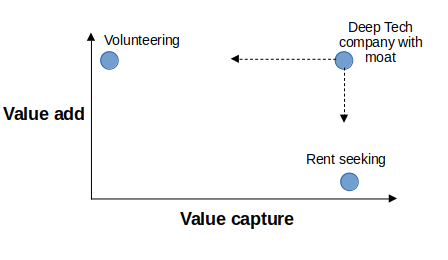
Some corollaries that I have thought of since then:
-
It is possible to capture value without adding value. Economics have a term for this:
rent seeking. An individual or organization that bases its existence on this position is probably in a very precarious position, because there is no treu value add, and the value capture can be taken away any time by regulation or goverment action. -
It is trivially easy to add value without capturing value: for example volunteering.
- In a competetive economy, an organization that adds value and captures value faces two types of pressures:
- Pressure to not be able to capture the same amount of value: this comes from competitors who try to replicate the same economic activity, unless the company has a strong moat against this.
- Pressure to not be able to add new value: this happens to large coroporations that are not able to innovate, and their main line of business eventually becomes outdated.
-
If price does not indivate value, then we cannot look at the price of a good or service and infer the value that it would add to us. In simple terms, a more expensive object is not necessarily more valuable to us.
-
Since value add is subjective, while value capture is quantifiable, it is possible to sell goods and service that biologically harm people (sodas, cigarettes, sugar-laden foods) and capture value, because the customers of these goods either believe they are deriving positive value (which could be due to advertising), or because they are additcted.
- Given the problems with only adding value or only capturing value, the best strategy is to aim to be an individual/company that adds a lot of value and captures a lot of value. In order to do this successfully and sustainably, one requires a sustainable competitive advantage, otherwise one is easily competed away (i.e. leftward pressure in the diagram above). One also needs to constanly continue to innovate in order to keep adding new value, otherwise one risks becoming a rent seeker (downward pressue in the diagram above).